French doors are beautiful, but with two doors meeting in the middle and plenty of glass, plenty of homeowners quietly wonder whether they’re secure enough for a family home. It’s a fair question, and worth answering properly before you rule them out. The good news is that modern uPVC french doors are built with security in mind. At uPVC Windows Expert, we make uPVC french doors for homes across NSW, and this guide explains, honestly, why people worry, the security features that address it, and how to choose secure french doors, so you can enjoy the light and access without trading away peace of mind.
| Quick answer
Yes, modern uPVC french doors are secure. They use multi-point locking that bolts the door into the frame at several points, reinforced frames, toughened or laminated glass and anti-lift hardware. Combined with a correctly installed frame, this makes them far harder to force than older single-latch timber doors, while still opening wide for light and access. |
Why do people worry about French door security?
The concern usually comes down to the design. French doors have two leaves that meet in the middle rather than a single door in a solid frame, and they’re mostly glass, so it’s natural to assume that meeting point is a weak spot and the glass is an easy way in. There’s also a lingering impression from older French doors, which sometimes relied on a simple central latch or basic bolts that weren’t especially hard to force. Those worries were more valid a generation ago, when door hardware was simpler, and glass was ordinary annealed glass. The reality with modern uPVC French doors is quite different, because both the locking and the glass have moved on considerably. Understanding what’s changed is the key to seeing why today’s French doors are a genuinely secure choice rather than a pretty compromise.
What security features do modern uPVC French doors have?
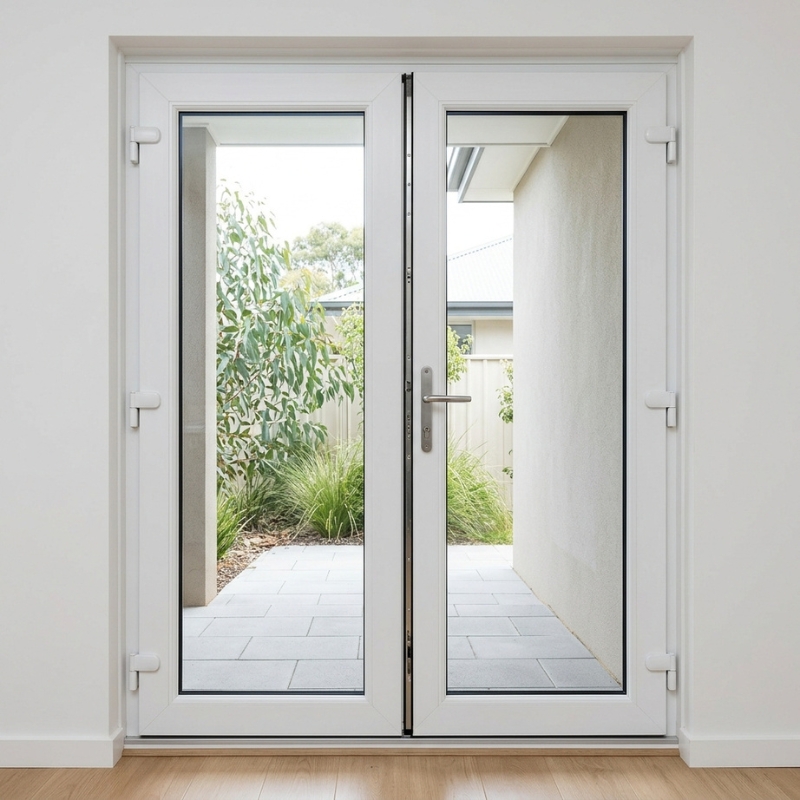
Today’s uPVC french doors are engineered with several layers of security working together. The most important is multi-point locking: instead of a single latch, one turn of the key throws bolts that engage the frame at several points up and down the door, pulling both leaves firmly into a reinforced frame and spreading any force across multiple points rather than one. The frames themselves are reinforced for strength and rigidity, so they resist being flexed or forced. The glazing is typically toughened or laminated safety glass, which is far more resistant to breakage than ordinary glass, and laminated glass in particular holds together even if struck, making it much harder to break through quietly. Many systems also include anti-lift and anti-jemmy hardware and hinge protection, which guard against the door being levered or lifted off. Together, these features make a modern uPVC french door far harder to force than the single-latch doors people picture.
How does installation affect security?
Even the best-made door is only as secure as its installation, which is why fitting matters as much as the hardware. A french door needs to be installed square, level and firmly fixed into a sound opening, so the multi-point locking engages properly and the frame is genuinely anchored to the structure rather than just sitting in the hole. If a door is poorly fitted, the locking points may not align correctly, or the frame may not be adequately fixed, which undermines all the built-in security features. That’s why professional installation is such an important part of the picture: it ensures the locks seat correctly, the frame is properly secured, and the door performs as designed. When we install french doors, getting the fit and fixing right is central to the job, precisely because the security you’ve paid for in the hardware only fully works when the door is fitted correctly.
How do you choose secure French doors for your NSW home?
If security is a priority, a few choices help you get it right. Look for doors with quality multi-point locking as standard, since that’s the single biggest contributor to how hard a door is to force. Consider the glass: toughened glass resists breakage, while laminated glass adds an extra layer by holding together when struck, which is worth thinking about for ground-floor and accessible doors. Reinforced frames and good-quality, anti-lift hardware round out the package. Beyond the door itself, insist on professional installation, because, as above, correct fitting is what lets all those features do their job. It’s also worth remembering that no door can be promised to be completely burglar-proof; the goal is to make your home a much harder and less appealing target, which quality uPVC french doors, well fitted, genuinely achieve. If a full pair of french doors isn’t right for a particular opening, uPVC hinged doors offer a secure single-door alternative with the same locking technology.
Frequently asked questions
Are uPVC french doors secure?
Yes. Modern uPVC french doors use multi-point locking that bolts both leaves into a reinforced frame at several points, along with toughened or laminated glass and anti-lift hardware. Correctly installed, they’re far harder to force than older single-latch doors. No door is completely burglar-proof, but quality uPVC french doors make your home a much harder target.
What locks do uPVC french doors use?
Most quality uPVC french doors use multi-point locking, where one turn of the key throws several bolts that engage the frame up and down the door, rather than a single central latch. This spreads any force across multiple points and pulls the leaves firmly into the frame. It’s the main reason modern french doors are so much more secure.
Is the glass in french doors safe?
Yes, modern french doors typically use toughened or laminated safety glass rather than ordinary glass. Toughened glass is much stronger and, if it ever breaks, does so into blunt pieces. Laminated glass holds together even when struck, which improves both safety and security. We can advise which glass suits your doors and location.
Are french doors a security risk compared to a single door?
Not with modern hardware. While two leaves might seem like a weak point, multi-point locking bolts both firmly into a reinforced frame, so a well-made, correctly installed uPVC french door is very secure. Any door’s security depends far more on its locking, glass and installation than on whether it’s a single door or a pair.
Final thoughts
French doors give you light, a lovely view and wide access, and modern uPVC versions give you that without sacrificing security. Multi-point locking, reinforced frames, toughened or laminated glass and correct installation together make them far harder to force than the single-latch doors people worry about. No door is completely burglar-proof, but well-made, well-fitted french doors make your home a genuinely tough target. To discuss secure uPVC French doors for your home, get in touch for advice and a quote.
| Book your free measure and quote
Want french doors without the security worry? Talk to us about secure uPVC french doors. Call uPVC Windows Expert on (02) 8747 0471. |