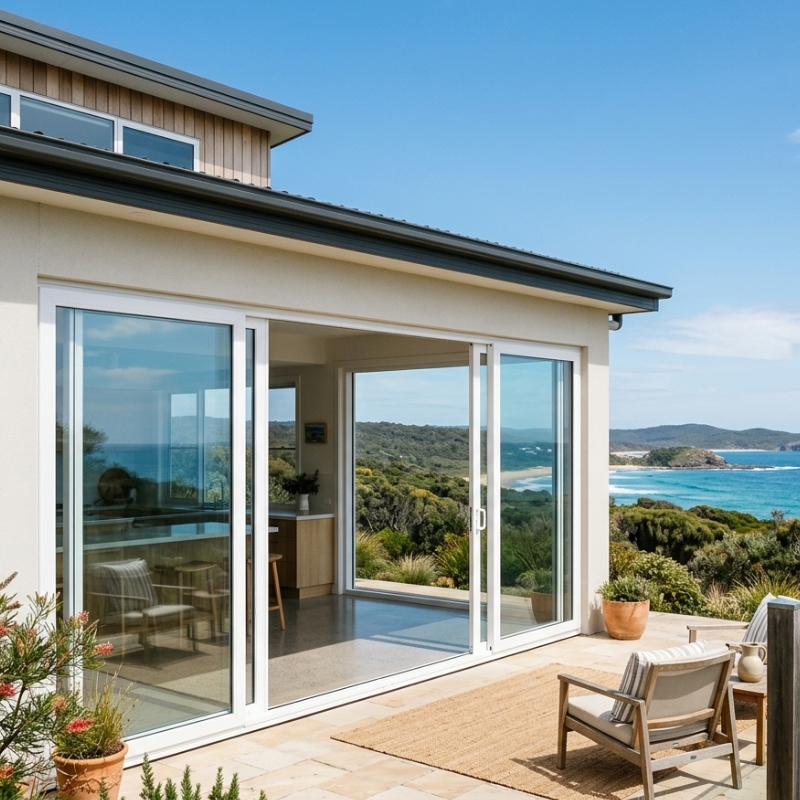
Coastal breezes, cicadas in the backyard and fierce summer heat make New South Wales an enviable place to live, yet those same elements punish every moving part of a home. Glazing lines take the first hit: salt settles on frames, ultraviolet light bakes seals and road noise drifts through gaps that seemed tight during construction. Homeowners considering an upgrade now ask a simple question: will modern materials last? uPVC sliding doors are proving they can do more than survive the state’s rough edges—they actively make homes quieter, drier and cooler. Early adopters in Newcastle, Wollongong and the Central Coast are reporting lower power bills and fewer maintenance weekends, and the data backs them up.
Visit our guide to uPVC sliding doors for design options and sizing advice.
The NSW Climate Pressure Cooker
A glance at the Bureau of Meteorology charts shows why material choice matters. Salt-laden air drifts more than 10 km inland on an average summer afternoon, carrying microscopic chlorides that corrode timber stain, craze aluminium powder-coat and eat into steel hardware. Western Sydney meanwhile clocks day-long temperatures above 35 °C for weeks at a time. Across the state, increased infill development places many dwellings closer to arterial roads and train lines, lifting background noise.
Traditional sliding door framing fights a battle on three fronts:
- Corrosion that blisters coatings and locks in moisture
- Thermal expansion that warps tracks, leading to sticky operation
- Sound leakage through uninsulated metal profiles
uPVC’s molecular structure and extrusion method tackle each issue differently.
Quieting Urban and Suburban Noise
Thicker glass is only half the answer to traffic rumble. Frame design matters because vibration transmits through the sash and meeting stile before it reaches the glass. A multi-chamber uPVC profile traps sound waves in a maze-like internal wall layout, turning low-frequency rumbles into harmless heat. Independent acoustic tests put typical reductions at 32–35 dB when double glazing is paired with a uPVC frame—a noticeable drop if your back fence lines the Princes Highway.
Clients in Parramatta who swapped out 1990s aluminium sliders reported that television volume now sits two notches lower during rush hour. The secret is continuous compression sealing: a flexible gasket runs the full perimeter of each panel, maintaining contact even after thousands of open-and-shut cycles. Timber frames often develop micro gaps as humidity swings, while metal styles can bow under direct sun, breaking the seal. uPVC’s expansion coefficient is close to the glass itself, so both elements move together and the seal stays even.
Refer to our case study on uPVC sliding doors and energy efficiency to see measured decibel readings before and after installation.
Standing Up to Salt Air
The coast’s mix of wind, spray and sand pushes nearly every exterior finish to fail earlier than its warranty suggests. uPVC sidesteps the problem by not relying on a coating in the first place. Colour and UV-stabilising titanium dioxide run through the full wall thickness; scratch the surface and you still expose the same material chemistry underneath, not raw metal or porous timber.
Hardware choice completes the job. Stainless-steel rollers, anodised tracks and sealed bearings come as standard on reputable systems sold into BAL-rated regions such as Lake Macquarie and Port Stephens. A quick hose-down every few months removes residual salt; no repainting, no rust converter, no fiddly sanding. Installers who specialise in coastal work often provide a yearly service plan, yet many owners find a soft broom and mild detergent are all that is needed to keep doors gliding.
Beating the Harsh Sun
Ultraviolet degradation shows up first as hairline cracks in cheaper plastics and chalky residue on painted aluminium. Modern uPVC formulations for Australian conditions include higher-than-European percentages of UV absorbers. Independent laboratory exposure, equivalent to around 15 years of Sydney sun, found gloss and colour shift remained within virtually undetectable ΔE readings.
Heat transfer is another measure of performance. A sliding unit built from uPVC frequently posts a whole-door U-value under 2.0 W/m²K with standard double glazing. Aluminium, even with a thermal break, struggles to match that figure without expensive glass upgrades. Lower U-values slow down radiant heat—good news for air-conditioners running flat-out on the state’s hottest afternoons. Residents in Dubbo and Tamworth who upgraded last year saw peak HVAC loads drop enough to consider downsizing future units.
The Australian Government’s Energy Rating programme echoes these results, listing uPVC frames among the top tier for insulating performance when matched with low-e or argon-filled glass.
Installation and Care Tips from the Field
Even the best profiles fall short if tolerances or clearances are off on day one. Experienced trades keep a checklist alive on site: plumb and square verified before fixing screws bite, drainage holes clear, sill packers resisting compression set. For homes in bushfire zones, look for BAL-40 compliant seals and metal reinforcing inserts.
Routine care is straightforward. Wipe tracks with a damp cloth, apply a dab of silicone-free PTFE spray to rollers once or twice a year and inspect weep holes after major storms. Isolation distances between frame and brickwork should remain flexible; reputable installers back-fill with closed-cell foam and a UV-stable sealant that accommodates tiny movements without tearing.
Homeowners comfortable with DIY can lift the active panel to vacuum grit from the lower rail—no special tools beyond a flat screwdriver to pop the cover caps. Nevertheless, annual servicing by the original fitter maintains warranty coverage and confirms that security interlocks engage properly.
Frequently Asked Questions
Do uPVC frames discolour in the Australian sun?
Modern formulations supplied to NSW include extra UV stabilisers. Field reports over a decade show negligible fading, provided the doors are genuine uPVC certified to AS 2047.
How often should I clean coastal installations?
Every three months is usually enough. Rinse with fresh water to dissolve salt crystals, then finish with a mild pH-neutral detergent if visible grime remains.
Can existing aluminium sliders be replaced without altering brickwork?
Yes, most opening sizes accept a retrofit uPVC unit. Frame adaptors cover minor gaps, and plaster reveals often stay intact.
Are uPVC sliding doors bushfire compliant?
Products rated up to BAL-40 are available. They pair metal reinforcing with intumescent seals, meeting NSW Rural Fire Service guidelines.
Will the tracks handle wheelchair access?
Low-profile threshold options sit flush with internal flooring, meeting AS 1428.1 circulation space requirements for mobility aids.
A Practical Next Step
A site measure provides the certainty paper specifications cannot. Bringing a sample sash to your living room lets you feel the weight, cycle the lock and judge finish quality in real light. Collect your rough opening sizes, note any view corridors you want to preserve and prepare questions about glass options. Our uPVC sliding doors page sets out the sizes, glazing options and lead times, and you can book a free measure and quote there. that suits coastal, rural or urban NSW life.