
Renovation budgets have changed, but value still matters
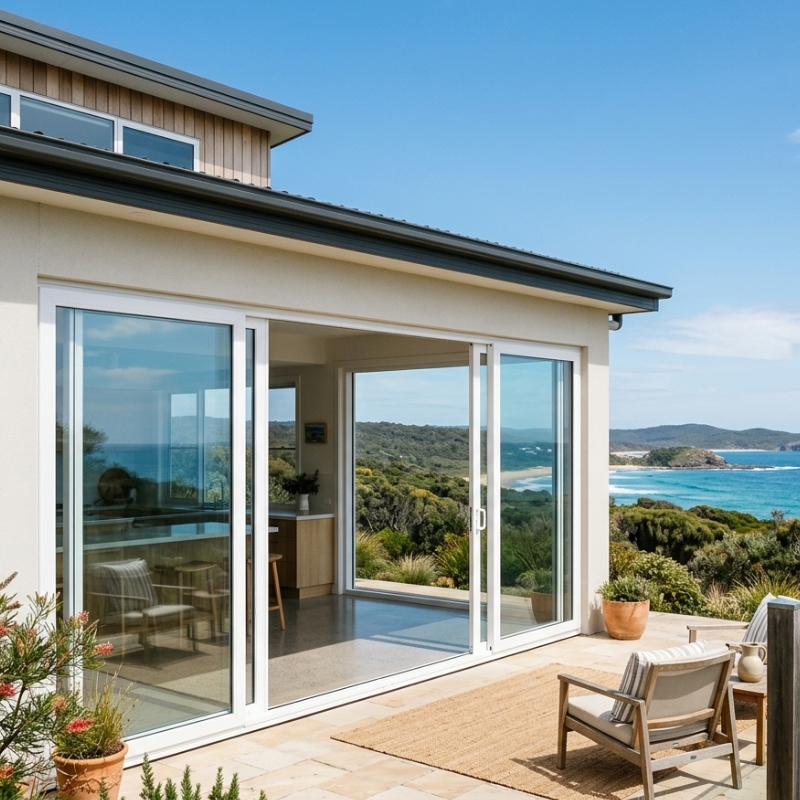
Homeowners across New South Wales spent much of 2024 and 2025 watching materials, trades and energy prices creep upward. When every line on the spreadsheet looks bigger than it did three years ago, it’s natural to ask whether the classics still pull their weight. Sliding doors sit high on that list. They open a full-width gap without eating into floor space. They pull a breeze straight through the house. And they join living areas to a deck or a garden in a single motion.
Price is what makes or breaks the decision, though. A builder’s quote usually breaks out the frame, the glazing, the labour and the hardware as separate items, so working out real value takes more than a glance at the total. Materials are the starting point. Aluminium stays popular for its slim sightlines. Timber appeals to anyone chasing heritage charm. uPVC has grown sharply on the back of energy concerns, and because it pairs insulation with low maintenance, the total cost of ownership can land lower even where the sticker price is much the same. If you’re pricing a renovation this year, an itemised quote on uPVC sliding doors is still a sensible benchmark.
Material comparisons: uPVC, aluminium and timber under the microscope
Sticker prices for a standard two-panel slider in metropolitan NSW now cluster within a few hundred dollars of each other, provided the glazing specification is identical. The real spread shows up across the following decade.
Aluminium wants periodic re-painting or powder-coat touch-ups near the coast. Timber wants sanding, sealing, and a good eye for early rot. uPVC asks for the occasional wash with soapy water and not much else, because the colour is baked through the profile and there’s no surface coating there to fail in the first place.
Thermal performance matters just as much. A double-glazed uPVC slider can reach a Uw value of around 1.8 W/m²·K. A standard aluminium unit with no thermal break sits a long way north of that, and even a thermally-broken aluminium system typically lands somewhere near 2.6 to 3.0. That gap shows up as fewer kilowatt-hours bleeding away on winter evenings, and less reliance on the air-conditioner through a February heatwave. With NSW power prices climbing hard over recent years, every marginal watt has started to matter.
Hardware life is the third angle, and it’s worth being accurate about why uPVC does well here. It isn’t that uPVC moves less with temperature. It actually expands more than aluminium does. What helps is that the frame itself is chemically inert, so there’s no corrosion bloom around the fixings and no coating to break down, while a good compression seal keeps air leakage low and grit out of the track. Rollers aren’t grinding over dirt by year four. Plenty of owners get a decade of trouble-free operation before a simple re-glaze or seal change, which sits comfortably ahead of timber’s maintenance timetable.
Hidden costs most renovators overlook
Budgeting rarely stops at the quote. Delivery access, structural changes and compliance can all nudge the number north in a hurry. Three extras deserve a spotlight:
- Lintels and structural headers. Widening an opening for a four-panel slider usually means a deeper steel lintel. Worth understanding why, though. The lintel is sized for the span and the load sitting above it, meaning the wall and the roof, not for the weight of the door itself, which bears down onto the sill. So a wider opening calls for a bigger beam whatever the frame happens to be made of.
- BAL ratings. Bushfire Attack Level rules apply across large parts of regional and peri-urban NSW, and reaching BAL-29 or BAL-40 adds cost whichever material you pick. Under AS 3959 the permitted frame materials are bushfire-resisting timber, metal, or metal-reinforced uPVC. All three are legitimate routes. What varies is the certification on the specific system, not the material category.
- Ongoing sealing and repainting. A trade repaint of timber doors can push into four figures every five to seven years. Factor that across a decade and the lifetime spend can dwarf the purchase gap between timber and uPVC.
Where a slider replaces a hinged French door, some owners worry about the cost of re-tiling or re-cladding around the tracks. In most brick veneer homes the sill rebate is minimal, and a low-threshold uPVC system can drop straight onto the slab with only modest tile trimming. Labour stays predictable. The plasterer rarely needs a second visit.
When sliding doors make the most sense in NSW homes
Sliding doors aren’t the default for every project. Several scenarios tilt heavily in their favour in 2026, though:
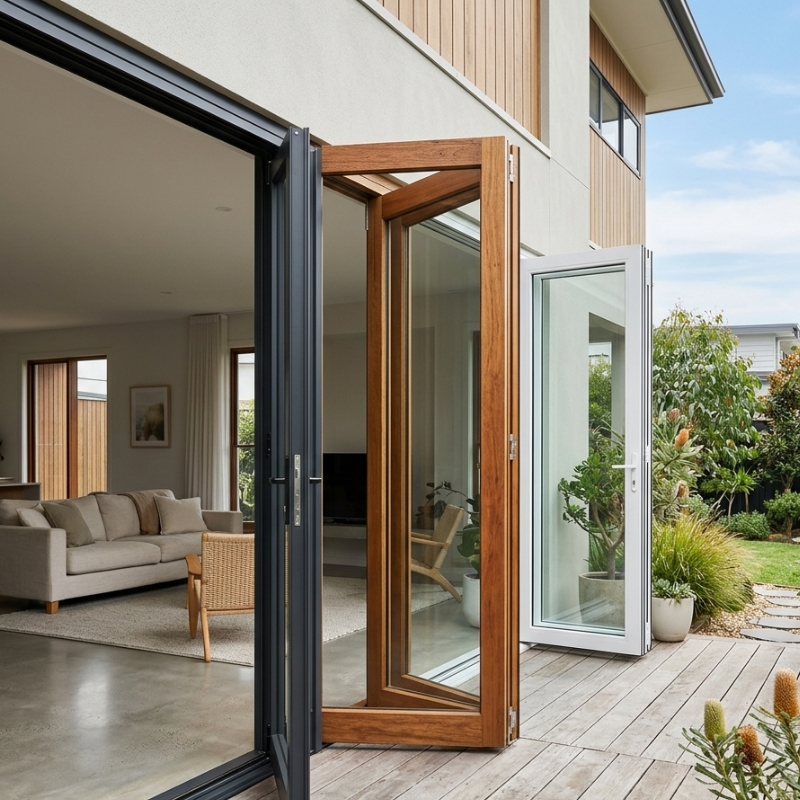
- Compact decks in inner-city terraces. A bi-fold stack needs room to concertina into. A slider leaves the whole footprint free for furniture.
- Bushfire-prone fringes such as the Blue Mountains. Large panes with minimal framing present fewer crevices for embers than a multi-leaf bi-fold does. Be precise about the compliance, though. Metal-reinforced uPVC is deemed-to-satisfy up to BAL-29. BAL-40 and above needs a complete system independently tested to AS 1530.8.1, and screening requirements still apply to low-level glazing. Ask for the system’s certification in writing rather than assuming the material clears it on its own.
- Energy-efficient retrofits chasing NatHERS upgrades. Tight air seals and a low Uw help designers chase that last elusive half-star once the rest of the envelope is already tuned. Swapping an ageing aluminium stacker for a modern uPVC slider can be the change that gets a design over the line.
For readers weighing daylight, ventilation and budget all at once, our deep dive into the energy efficiency of sliding doors unpacks the performance figures in plain terms.
Quick maintenance guide for long-term savings
A cost-effective purchase only stays that way if the upkeep is simple. The routine for a uPVC slider fits on the back of a hardware receipt:
- Vacuum the track twice a year.
- Wipe the frame with warm water and a drop of dishwashing liquid.
- Check the drainage holes after heavy rain. Clear them with a cotton bud if water sits for more than a minute.
- Dab a silicone-based lubricant on the rollers once a year.
No sanding. No painting. No special solvents. Even the glazing beads pop out with a blunt plastic tool if a pane ever cracks. A ten-minute job now saves a service call later.
If you want an independent read on frame materials, the Australian Government’s Your Home guide runs through the trade-offs of timber, aluminium, thermally-broken aluminium and uPVC side by side. It’s a neutral starting point, and worth reading before you take anyone’s word for it. Ours included.
Bottom line on cost-effectiveness
Rising material and energy prices might prompt some second-guessing. Sliding doors have held their ground, though, because they tick several boxes at once. They open wide without eating floor space. They handle the NSW climate with minimal fuss. And specified in insulated uPVC, they cushion a household against every spike on the electricity bill. Add the absence of repainting bills and the lean maintenance routine, and the ledger still comes out in their favour for 2026.
Renovators after an indoor-outdoor link that won’t demand constant attention should keep sliding doors, and uPVC models in particular, near the top of the shortlist.